Step toolbox, deck plate or both?
- Step toolbox. A box with a step built into the front. It gives you storage and a way up to the cab or deck in one unit, usually mounted on the frame rail.
- Deck plate and catwalk. A flat walking and work surface behind the cab, often with a grab rail, so you can reach the fifth wheel, air lines and lights without standing on the frame.
- Combination. Many trucks end up with a box under the step and a plate behind the cab, built to match so the layout makes sense.
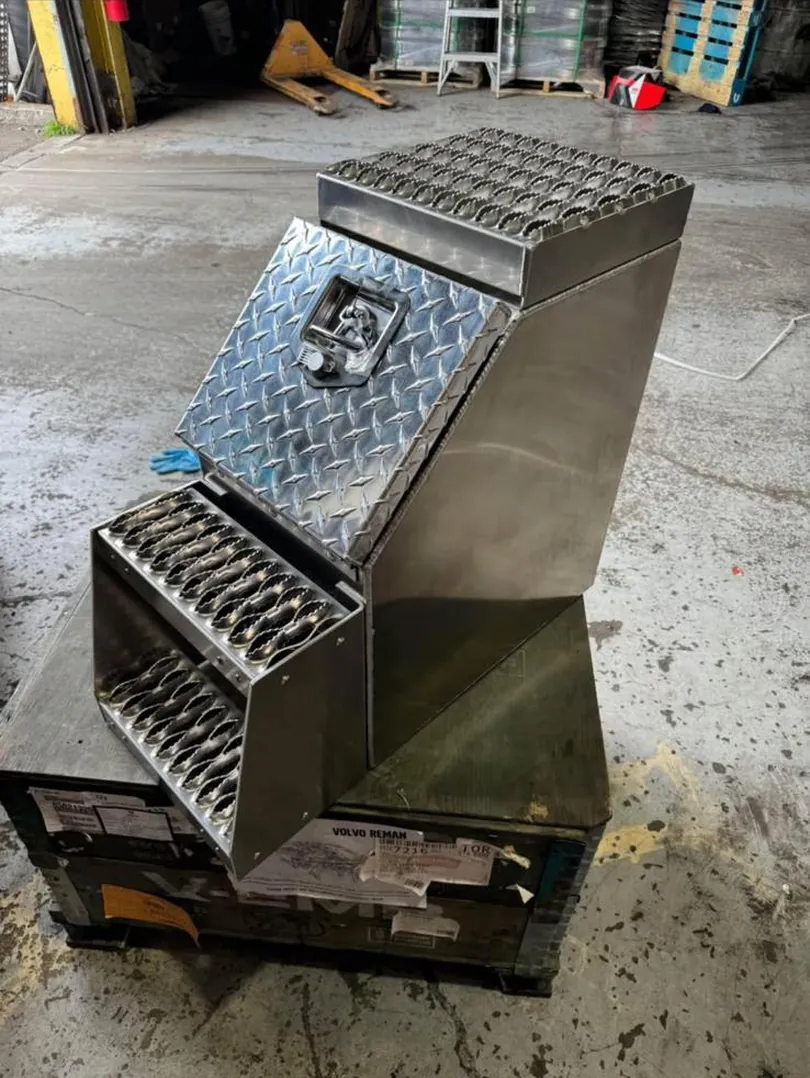
What to measure before you order or build
- Free frame space. Measure the length of clear frame rail between the cab, the fuel tank, the battery box and the rear components. Other guides give box sizes but forget that every truck has different gear in the way.
- Tire and mudflap clearance. A step that sits too close to the tire gets hit with slush and rubbed by chains.
- Step height. A good first step is a height you can use in winter boots, with a surface that grips when wet.
- Door swing. The cab door and the box lid must both open fully without hitting each other.
- Fifth wheel and trailer swing. For a deck plate, check the trailer nose clearance on tight turns and when the fifth wheel slides.
- Air lines, wiring and lights. Do not cover connections you need to reach, and do not pinch lines.
Aluminum or steel?
Aluminum is the usual choice for toolboxes: it is light and does not rust. Steel is stronger for a given thickness and can be better where a bracket carries load. The honest answer is that it depends on the part. A good fabricator will often use aluminum for the box and steel for the frame mount, with the two kept from touching directly so they do not corrode each other. Ask what is being used where, and ask about the thickness of the walking surface and the supports under it.
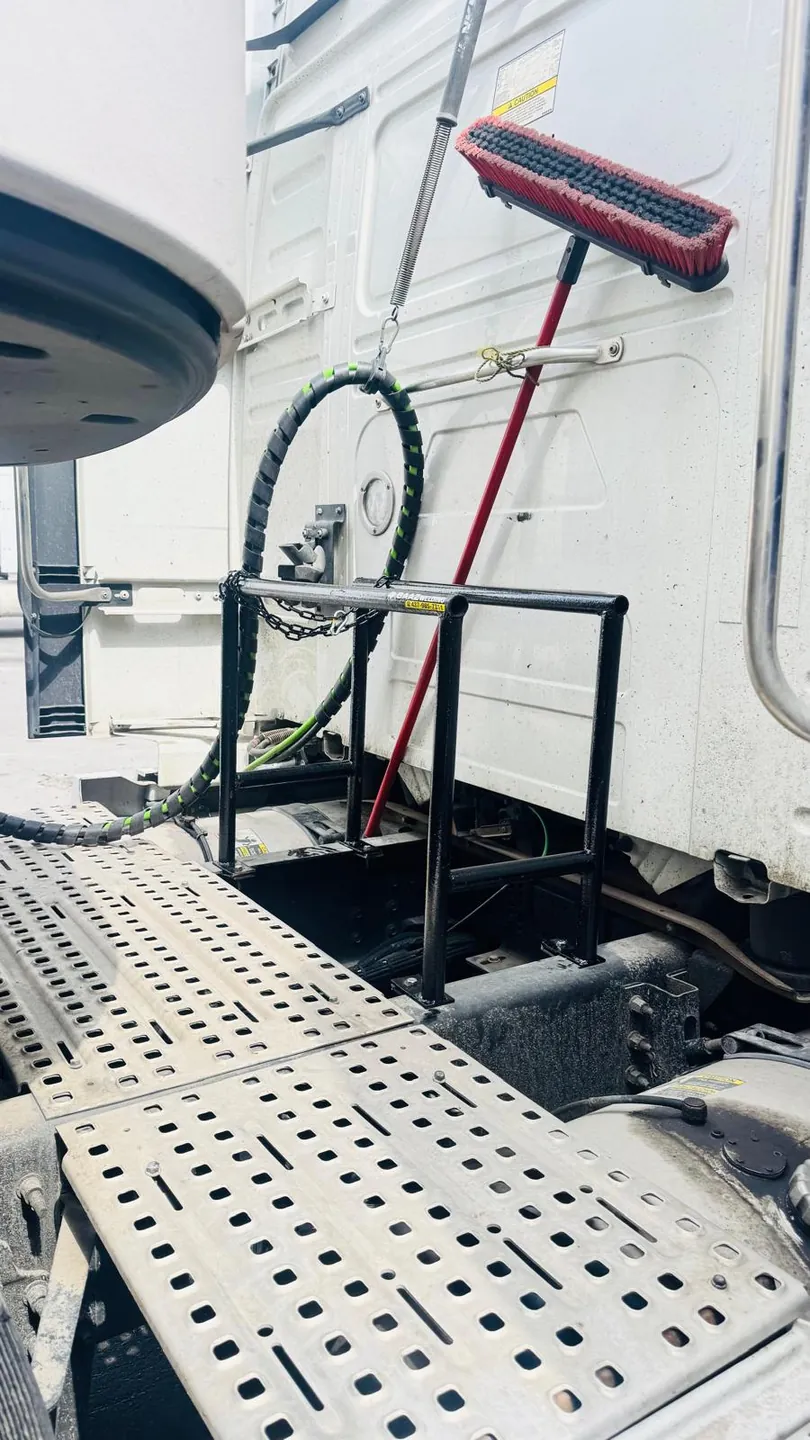
The thing most guides skip: how it hangs off the frame
Product pages talk about box size, lid style and finish. They rarely say how the load gets into the truck. A step takes a person's full weight, with a bounce, on one edge. A box full of tools is heavy and swings with every bump. If the mount is thin, uses too few fasteners or bolts to a light bracket instead of the frame, it will crack at the weld or loosen and rattle. Ask how the unit ties to the frame, how many mounting points there are, and whether gussets support the corners. A walking surface should have supports underneath, not just a thick sheet.
Details that make it last
- Drainage and sealing. A box that holds water rusts what is inside and freezes the lid. Look for drain holes and a lid that sheds water.
- Locks and latches. Choose hardware that works with winter gloves and does not seize with salt.
- Grip surface. Diamond tread or a gripping step surface, kept clear of ice.
- Edges and corners. Rounded, welded corners last longer than bent, thin ones.
- Finish. Ask what protects the steel parts in Ontario winters.
Questions to ask any fabricator
- How many mounting points tie into the frame, and what are they bolted or welded to?
- What thickness is the box, the step and the walking surface?
- What happens to water that gets in the box?
- Will it clear my tires, fuel tank, battery box and air lines?
- If a corner cracks in a year, can it be repaired, and where?
A builder who answers these clearly, with photos of past work, is usually one you can trust. A builder who only talks about looks is not.
Repair or replace?
- Look at the welds and corners for cracks, especially where the box meets the bracket.
- Check the step surface for bending or flex.
- Check the mount. Loose or elongated holes, cracked brackets and rust at the frame are warning signs.
- Decide. A cracked weld or a split corner can often be re-welded and reinforced. A crumpled or corroded box is better replaced.
Many repairs can be done at your yard by our mobile welding truck. Aluminum cracks need the right filler and prep, which we explain in our guide to welding aluminum on site. New builds are made in our Brampton shop.
What we build and where we work
Steps, toolboxes and deck plates are part of our welding and fabrication work, along with tire carriers, headache racks and deer guards and bumpers. We serve Brampton, Mississauga, Toronto, Vaughan, Milton, Oakville and Caledon, 7 AM to 7 PM, seven days a week, with no overnight service.
How to get a quote
Send photos of the space (or the broken part), the truck make and model and what you want to store or reach to WhatsApp 437-985-7311. We tell you what is possible and give a price before we start.
Call 437-985-7311 WhatsApp photos
Frequently asked questions
Can you build a custom step toolbox or deck plate for my truck?
Yes. Steps, toolboxes and deck plates are part of our custom fabrication work in our Brampton shop. Send the truck make, the space you have and photos, and we confirm what is possible before we build.
Aluminum or steel for a toolbox or step?
Aluminum is lighter and does not rust, which matters on a truck that sees Ontario road salt. Steel is stronger for the same thickness and is often the better choice for a heavily loaded step or a frame bracket. We choose by the job, and often use both on one build.
Where can a step toolbox be mounted?
Commonly on the frame rail beside the cab, or on the deck behind the cab. The mount needs to tie into solid frame steel, and the box must not block the fuel tank, battery box, air lines or fifth wheel clearance.
Can a deck plate or catwalk be added to a truck that does not have one?
Usually yes, if there is solid frame to support it. We build the frame under the plate so the walking surface does not flex, and we keep air lines, lights and fifth wheel travel clear.
My step or toolbox is cracked. Can it be repaired?
Often yes. A cracked weld or a split corner can be re-welded and reinforced, and our mobile truck can do many repairs at your yard. Badly corroded or crumpled metal is better replaced.
How much does a custom toolbox or step cost?
The price depends on the size, the material and the mounting, so we do not quote from a description. Call or WhatsApp 437-985-7311 with photos and we give you a price before we start.
Related guides
More Baaz Welding guides · Welding & fabrication · Custom tire carriers