Why a tire carrier is a welding job
Store-bought clamp-on and stake-pocket carriers are made for light trailers. A commercial trailer or tractor has a different problem: a heavy wheel that hangs off the frame and gets shaken constantly. Most advice online is for pickup and utility trailers and says little about heavy units. The weak point is almost never the tire. It is the mount, the weld or the leverage on the bracket.
Where can the spare go?
- On the deck or behind the cab (tractor). Easy to reach and to lift off. The carrier is built to fit the deck frame and the space you have.
- Under the trailer frame. Keeps the tire out of the way, but you have to get under the unit to lower it, and the area is full of salt and spray.
- On the side or the rear of the trailer. Quick to reach, but adds width or length and can block lights, the plate or the doors.
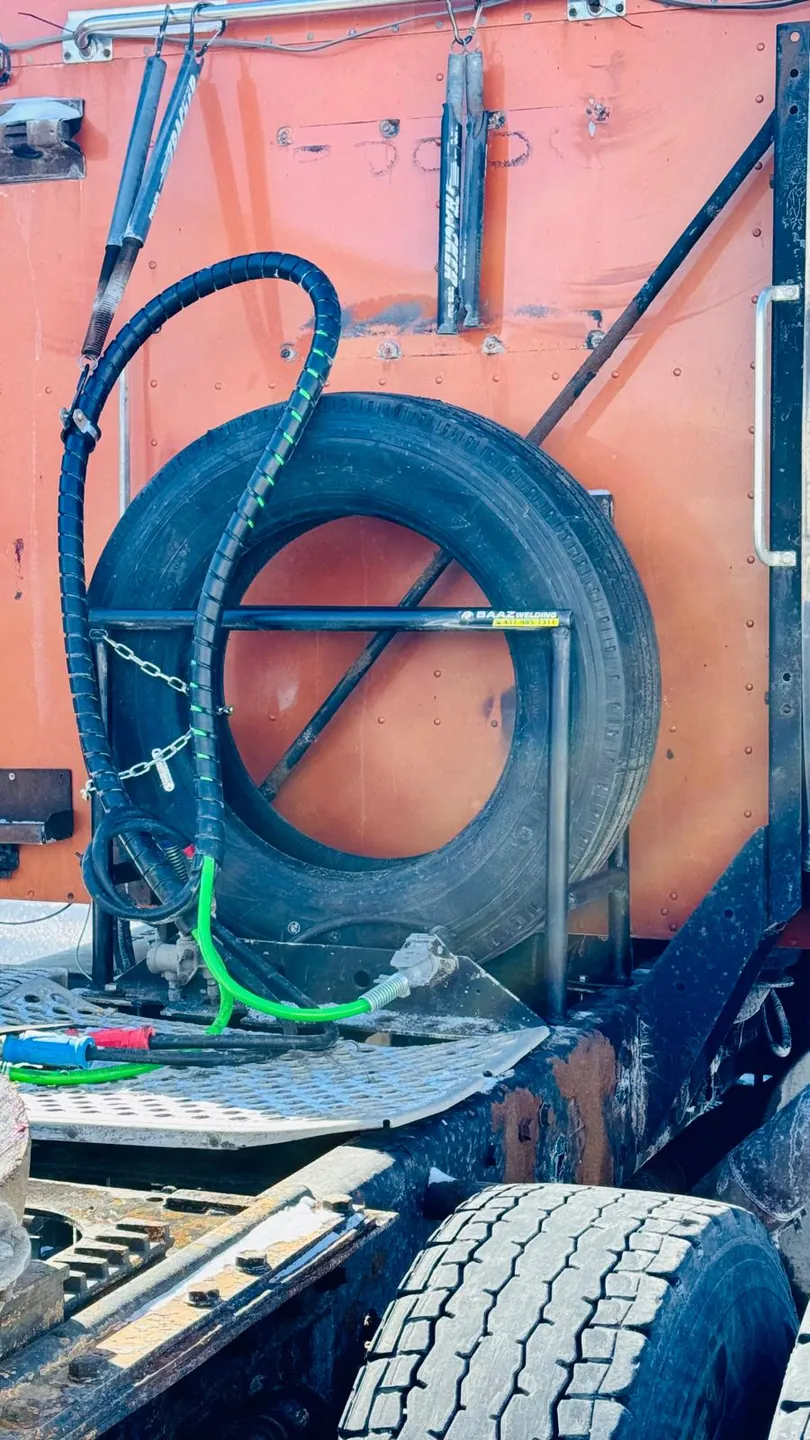
There is no one correct side or position. Pick the place where you can lift the wheel safely, where the carrier ties into solid frame steel, and where nothing else is blocked.
What to check before you build or buy
- Wheel and tire weight. Weigh or look up your actual spare, steel or aluminum wheel included. The carrier and its welds need to be made for that weight, not the tire alone.
- Leverage. A tire hanging away from the frame pulls on the bracket like a long lever. The further out it hangs, the stronger the arm and the frame tie-in must be.
- How it ties to the frame. The carrier should land on real frame steel with gussets at the joints. A mount fixed only to thin sheet or a light bracket will crack.
- How you lift it. If you cannot get the wheel on and off at the side of a road in winter, you will not use the spare. Think about the lift height and the space around the unit.
- Lights, plate and doors. Check that the tire does not cover lights, reflectors or the plate, and that doors and ramps still open fully.
- Hold-down. A good carrier clamps the wheel so it cannot spin or bounce. Take up any slack so it does not rattle.
- Theft. Spares are stolen. A lockable hold-down is worth thinking about from the start.
- Salt and rust. Ontario salt eats steel. Ask about paint or coating so the carrier does not rust through in a few winters.
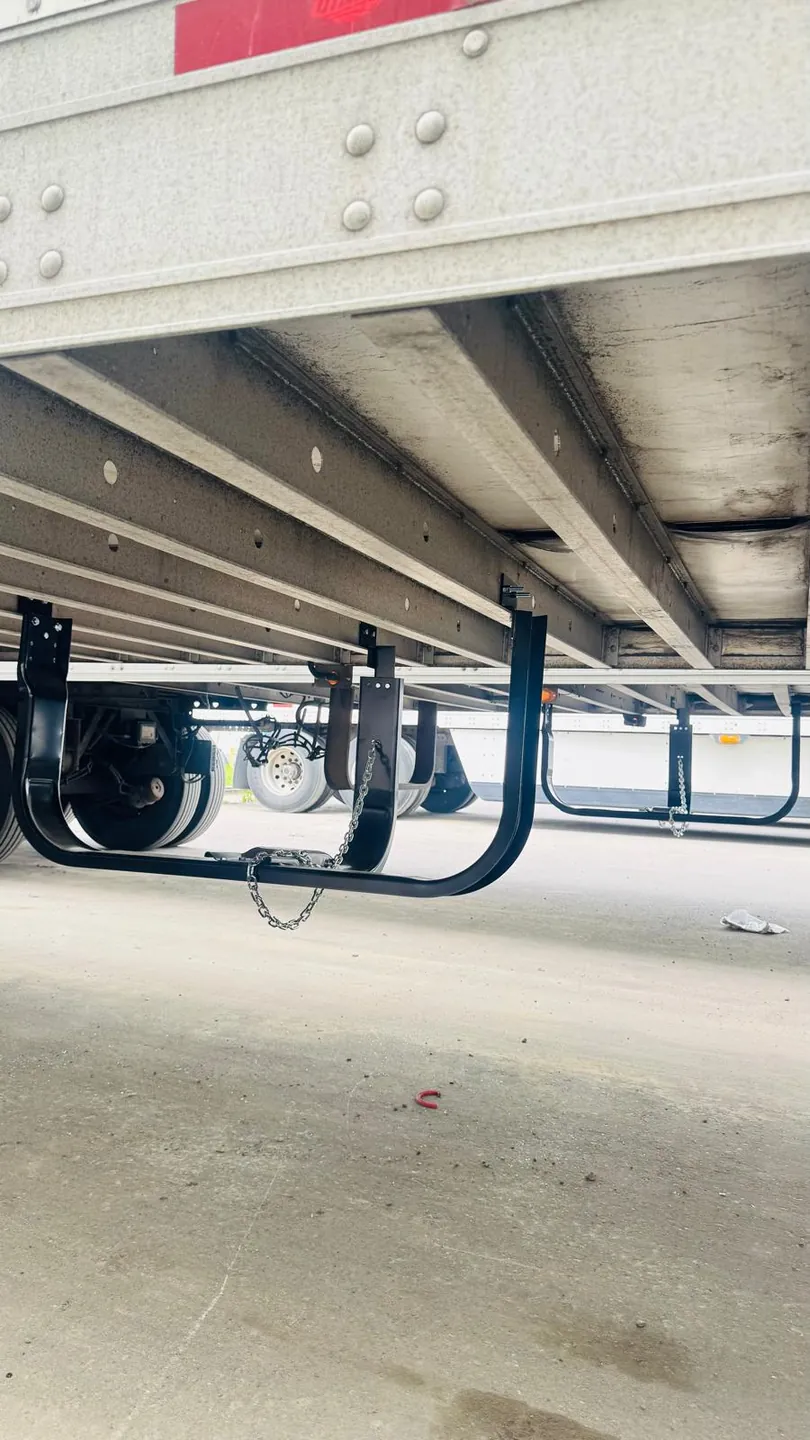
One thing most guides skip: the person lifting it
Most carrier advice talks about the bracket and forgets the driver. A heavy wheel has to be lifted off at the worst moment: in the rain, on a gravel shoulder, with traffic nearby, often alone. Before you settle on a spot, stand next to the unit and imagine doing it in winter gloves. A mount at a sensible height, with a hold-down you can open with one tool, gets used. A mount that needs a jack, a ladder or two people stays unused until the day you need it. It is also worth asking for a design that lets you roll or slide the wheel rather than lift it straight up, where the space allows.
The rattle is a warning
A carrier that clanks is usually telling you something: a loose bolt, a worn pivot, a hold-down that no longer clamps, or a crack that is starting at a weld. Rattle means movement, and movement means the steel is flexing where it should not. Look at the welds and brackets, and look for rust streaks or bright metal where parts rub.
Repair or replace?
- Inspect the welds for hairline cracks, especially at the arm and the frame mount.
- Check for bends where the carrier was hit or overloaded.
- Look at the metal thickness where rust has eaten it. Thin, pitted steel is not worth welding.
- Decide. A cracked weld or a lightly bent arm can often be re-welded and reinforced. A carrier that is rusted through or repeatedly bent is better replaced with a stronger build.
Repairs can often be done at your yard by our mobile welding truck. A new custom build is made in our Brampton shop.
What we build and where we work
Tire carriers for trailers and truck decks are part of our welding and fabrication work, along with generator carriers, steps, toolboxes and headache racks. If your carrier hangs from a trailer with a worn frame, see our guides on cracked cross members and suspension repair. We serve Brampton, Mississauga, Toronto, Vaughan, Milton, Oakville and Caledon, 7 AM to 7 PM, seven days a week, with no overnight service.
How to get a quote
Send a photo of where the carrier will go (or of the broken one), the spare tire size and the unit type to WhatsApp 437-985-7311. We tell you what is possible and give a price before we start.
Call 437-985-7311 WhatsApp photos
Frequently asked questions
Can you build a custom tire carrier for a semi trailer or tractor?
Yes. We build tire carriers for trailers and for truck decks in our Brampton shop. Send the unit type, the spare size and photos of where you want it, and we confirm what is possible before we build.
Where is the best place to mount a spare on a trailer?
It depends on the unit. Under the frame keeps it out of sight but makes it harder to lift in and out. A deck or rear-mounted position is easier to reach. Whatever the spot, it needs solid frame support, and the tire must not block lights, the plate or access to other parts.
Why does my spare tire carrier rattle?
Almost always from play in the mount: loose bolts, worn pivot points, a worn hold-down or a bracket that has cracked. Rattle is also an early warning, because a mount that moves is a mount that is fatiguing.
Can you repair a cracked or bent tire carrier instead of replacing it?
Often yes. A cracked weld or a bent arm can be re-welded and reinforced at your yard by our mobile welding truck. If the steel is badly rusted or kinked, a new carrier is the better choice.
Do you weld the carrier to the trailer or bolt it on?
It depends on the frame and the load. We decide the mounting method from the unit, and we keep the mount tied into solid frame points. Tell us the trailer make and send photos and we advise before starting.
How much does a custom tire carrier cost?
The price depends on the unit, the tire size and the design, so we do not quote from a description. Call or WhatsApp 437-985-7311 with photos and we give you a price before we start.
Related guides
More Baaz Welding guides · Welding & fabrication · Truck deer guards