Where trailer roofs usually leak
Most trailer roof leaks start at one of a few places:
- Seams and sealant. Sun, rain and winter temperature swings dry out sealant until it cracks.
- Rivets and fasteners. A loose or missing rivet lets water in slowly.
- Punctures and tears. Low branches, a low clearance strike or a dropped tool can open the skin.
- Vents, roof lights and penetrations. Old gaskets leave gaps.
- Dips where water pools. A sagging roof or a bent bow holds standing water on the seams.
- Cracks in the roof skin or at the front header, where the roof flexes the most.
Step 1: Find the real entry point
The stain you see inside is almost never directly under the hole. Water runs along roof bows and insulation before it drips.
- Start inside. With the trailer empty, look at the ceiling and upper walls for stains, rust, daylight, damp or swollen insulation. Take photos.
- Check the roof itself for cracks, lifted seams, missing rivets, old patches and dents that hold water.
- Hose test in sections. One person on the inside, one with a hose outside. Start at the lowest point and work up, a small section at a time, so you know which section leaks.
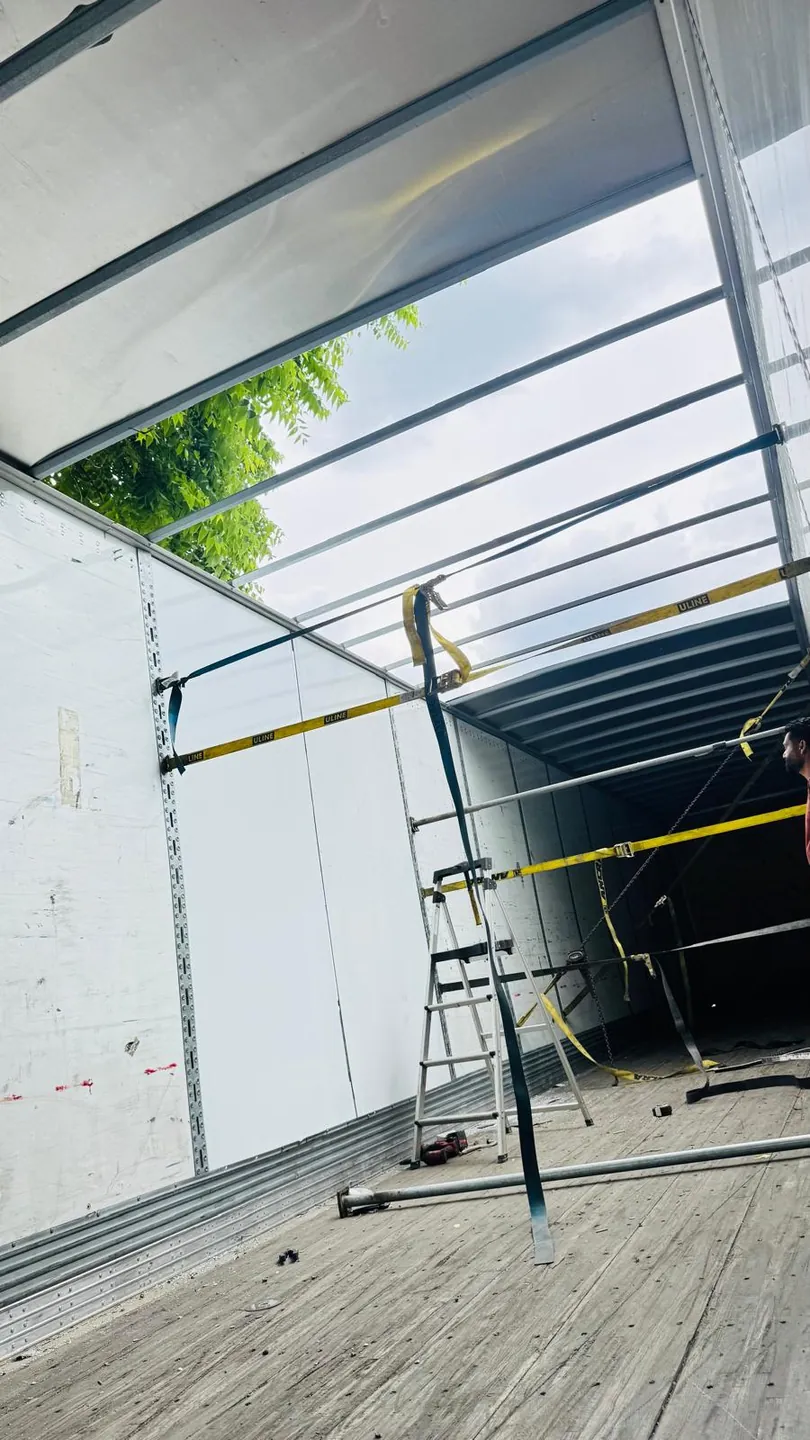
Step 2: Seal it, patch it, or weld it
Small seam or rivet leak: seal it
Remove old sealant and loose rust with a wire brush, clean with a degreaser or alcohol, and let it dry fully. Use a urethane or silicone sealant made for metal roofs, not household caulk. Seal over the rivet heads and along the full length of the seam, then hose test again after it cures.
Hole or short tear in sound skin: patch it
The damaged area is trimmed back to clean metal and a patch larger than the damage is fitted and sealed around the edges. Match the metal and the fasteners to the roof so you do not create corrosion at the joint. Where the metal allows, a welded patch holds better than sealant alone because it does not work loose.
Cracked skin, bent bows or a sagging roof: this is a metal job
Sealant on a crack that is still moving only buys a few weeks. If the roof sags and holds water, or a bow or the front header is bent or cracked, the structure has to be straightened or repaired first, and then the skin. See our guide to side panel repair, which covers the same patch-or-replace logic for walls.
| What you see | Usual fix |
|---|---|
| Dried or cracked sealant at a seam | Clean and reseal |
| Loose or missing rivets | Replace fasteners and seal |
| Small puncture, sound skin | Patch |
| Crack in skin or at header | Weld or replace section |
| Water pooling, bent or sagging bow | Repair structure, then skin |
What most leak guides leave out
- Look behind the skin on a reefer. A reefer roof and walls contain insulation. Wet insulation stops insulating and keeps the metal and posts damp, so a leak you ignore can turn into a much bigger repair. Sealing the top without dealing with wet material underneath hides the problem rather than fixing it.
- The roof structure matters as much as the skin. Most guides stop at sealant. A bent roof bow creates the low spot where water collects, and the leak returns no matter how much sealant you use.
- Welding near insulation needs a plan. Heat and sparks can damage or ignite material behind the skin, so we check what is behind the metal before we weld and we cut out or replace a section rather than weld blind if that is the safer way.
- Fix the cause. Low clearances and overhanging branches at a regular yard will damage the roof again.
How to prevent the next leak
- Walk the roof or check it from a ladder every few months and after any low clearance strike or storm.
- Reseal seams and rivet heads before the sealant fails, not after.
- Replace old vent and light gaskets.
- Do not leave a puncture taped for months; tape is a short-term cover only.
What to send us for a quote
Text or WhatsApp 437-985-7311 with: one photo of the roof, one close-up of the damage or stain, one from inside, and the trailer type (dry van, reefer, box body) and roof material if you know it. We quote before we start. Our welding truck comes to your yard or dock in Brampton, Mississauga, Toronto, Vaughan and Milton, 7 AM to 7 PM, seven days a week.
Read more about our trailer roof and side panel repair, aluminum trailer welding, and mobile trailer welding. If damage has also reached the doors, see trailer doors that will not close.
Call 437-985-7311 WhatsApp photos
Frequently asked questions
Can I fix a trailer roof leak myself?
A small leak at a seam, rivet or vent can often be sealed with a urethane or silicone sealer made for metal roofs, after cleaning the area back to bare, dry metal. Household caulk does not survive temperature swings and road vibration. A tear, a crack in the skin, or a sagging roof bow is a metal repair and should be looked at by a welder.
How do I find where the roof is leaking?
Work from the inside first. Look for stains, rust streaks, dripping at the roof bows or damp insulation. Then have someone run a hose over small sections of the roof, one section at a time, starting low and working up, while you watch inside. Water often travels along a bow before it drips, so the entry point can be well away from the stain.
Why is a leaking reefer roof worse than a leaking dry van roof?
A reefer has insulation inside its walls and roof. Once water gets in, the insulation holds it, loses its value, and keeps the metal around it wet. That is a bigger problem than a stain on a dry van ceiling, so a reefer leak should be fixed sooner.
Is it safe to weld a reefer roof?
Welding near insulation needs care, because heat and sparks can damage or ignite the material behind the skin. We assess what is behind the metal first and tell you honestly if a section should be cut out, replaced or sealed instead of welded. We do not weld blind.
Can you repair aluminum roof skin?
Yes, we weld aluminum and steel on the truck. Thin aluminum needs careful heat control, so we judge each repair on its own and tell you if a section is better replaced.
How much does a trailer roof repair cost?
It depends on the size of the damage, the material, and whether roof bows or insulation are involved. We do not guess prices from a description. Send photos on WhatsApp to 437-985-7311 and we quote before we start.
Related guides
More Baaz Welding guides · Cracked trailer cross member · Landing gear repair